
Supporting your child's maths without becoming their teacher
Helping doesn't have to mean teaching it yourself.

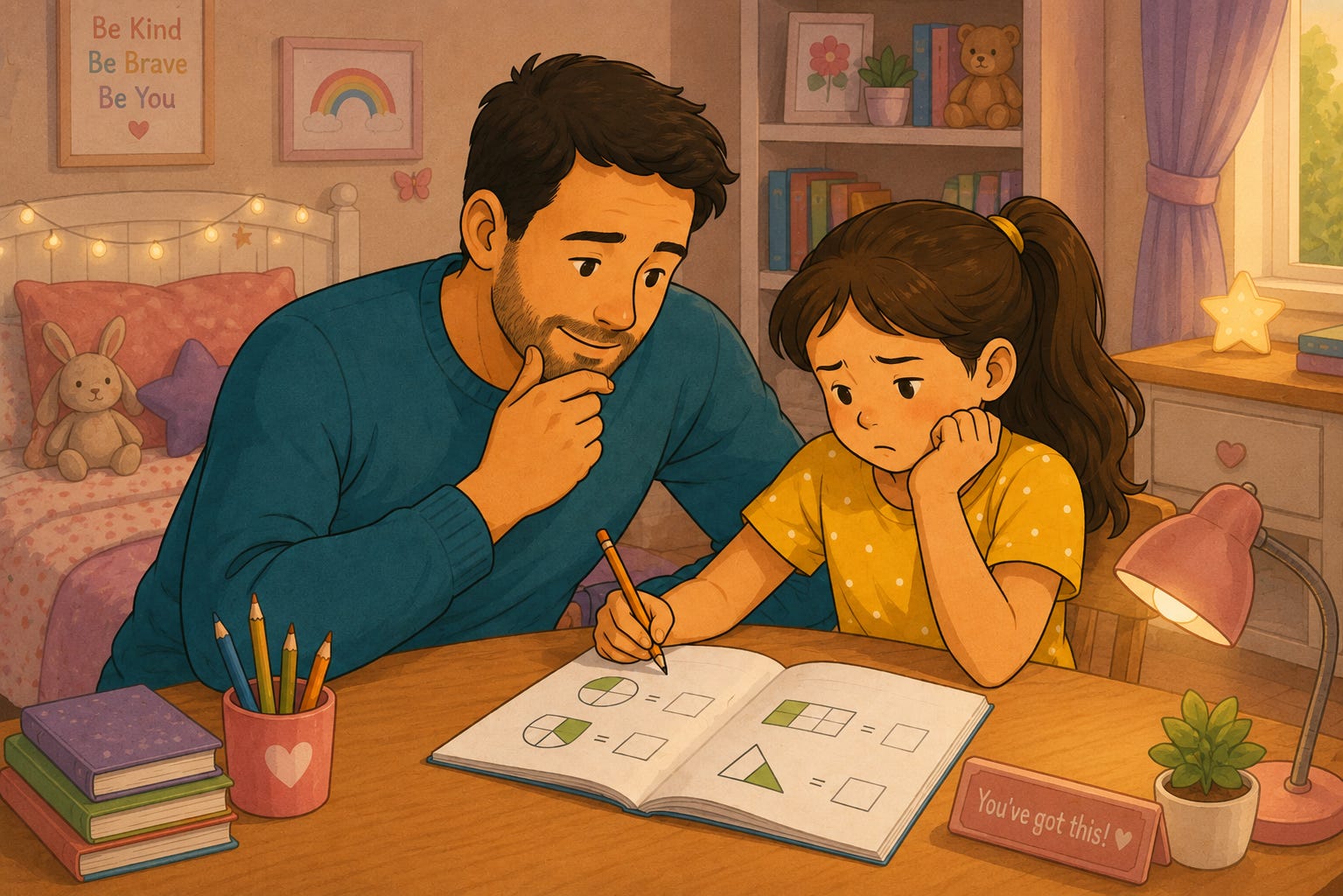
Homework is out on the table, and your child is stuck on a fractions question. You sit down to help, read it once, then again, and realise you’re not completely sure how to explain it.
That small moment of “I should know this” is more common than most parents admit.
Caring and knowing are two different things
Most parents assume that if they cared enough, they would be able to help with their child’s maths. So when they can’t, it feels personal. It can feel as if not knowing the maths says something about how much they care.
But caring about how your child is going and knowing the content are two different things.
Caring is noticing when they are frustrated, asking how school went or paying attention when something feels off. Knowing is being able to explain what a common denominator is, or why you flip a fraction when dividing by it.
One is about your child. The other is about the syllabus.
It is easy to treat those things as the same, and then quietly feel like you are falling short when you cannot do the second. But you are not falling short. Nobody expects you to be across the full maths curriculum, from place value to trigonometry, ready to explain any of it on demand.
That was never meant to be the job.
It gets harder as they get older, not easier
In the early years, helping can feel manageable. Counting, times tables, simple fractions. You might be rusty, but you can usually find your way back.
Then the maths changes. Algebra appears, then trigonometry, followed by functions. The language becomes less familiar, the methods are not always the ones you learned, and the gap between wanting to help and being able to explain it gets wider.
What was a minor stretch in Year 3 can become something you genuinely cannot help with by Year 9. That is not a sign you have fallen behind. It is simply the reality of the curriculum moving past what most people use in everyday life.
Most parents are not walking around ready to explain algebra after dinner. That does not mean they are failing their child. It makes them normal.
Helping is not the same as teaching
Here is the part that often gets missed: a parent’s value was never in knowing the answer. It is in what happens around the learning.
Sitting with your child while they work through something hard. Asking “how did you get to that?” instead of “here’s how you do it.” Noticing when they are avoiding a topic instead of tackling it.
None of that requires knowing the maths. All of it requires showing up.
Sometimes the most helpful thing a parent can do is not explain the next step, but slow the moment down. Asking “show me what you tried” or “where did it start to feel confusing” does not require you to know the answer. It helps your child stay with the problem long enough to understand where they are stuck, and it sends a message that matters: being stuck does not mean they have failed, and they do not have to hide it.
The pressure parents put on themselves
Many parents assume they cannot really help unless they understand the content themselves.
That’s the wrong trade-off. Parents can sometimes feel their only two options are “learn it myself” or “leave them to it.” But there is a lot of ground in between, and that is where much of the real support actually happens.
Helping your child does not have to mean knowing every answer. Sometimes it means knowing they are supported, seeing when they are stuck, and being there in the moments that matter. And if your child needs the right explanation or more practice with the concept itself, that is not something you have to work out alone either.