
When a child needs a different explanation
More practice isn't always the answer. Sometimes what a child needs is a different way in.

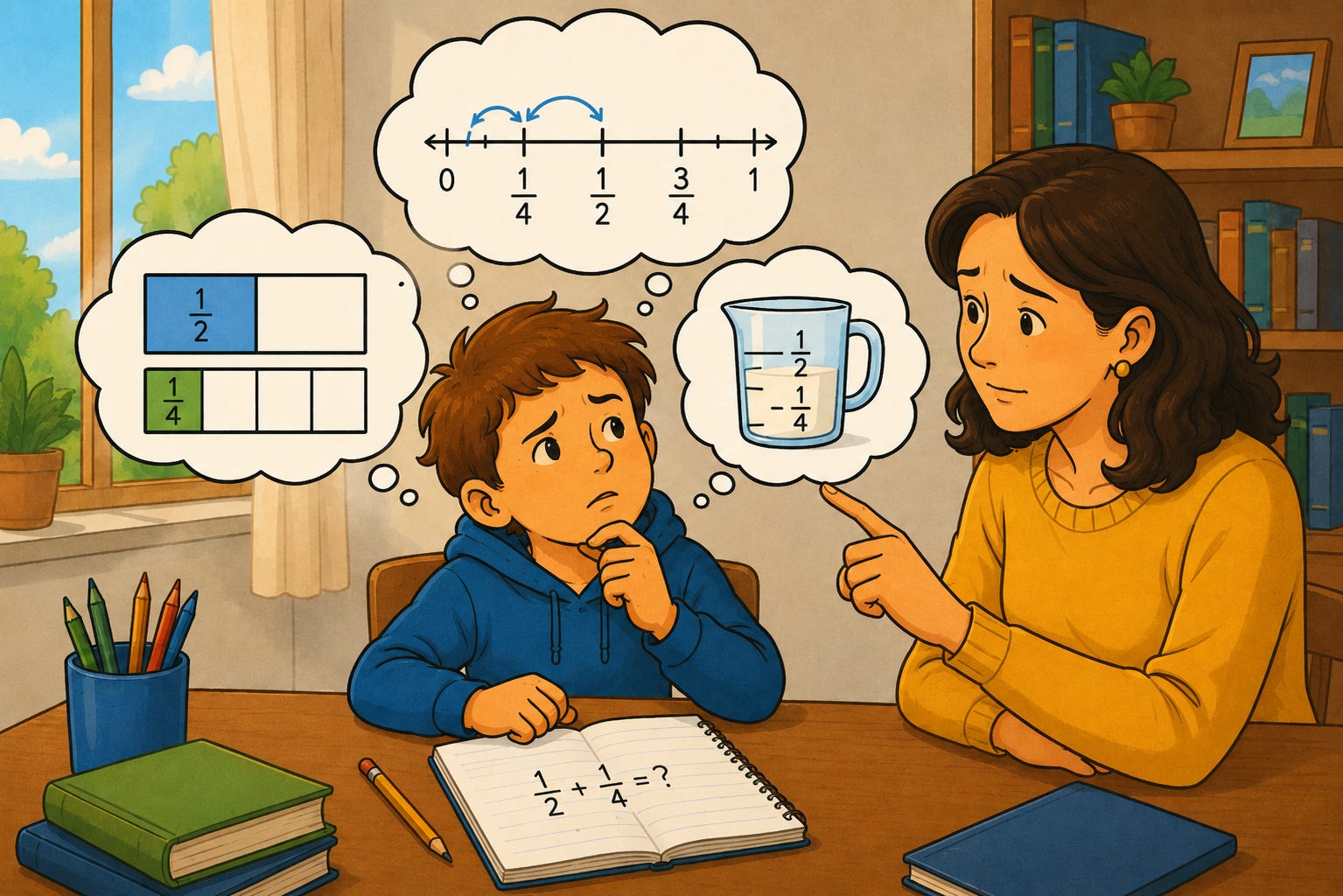
There’s a moment most parents will recognise. Your child is stuck on the same kind of problem they were stuck on yesterday. You sit down beside them, explain it the way it was explained to you when you were their age, and watch them stare back, no closer to getting it.
So you try again. Maybe slower. Maybe with a different example. And sometimes, something shifts. They see it, they get it. And neither of you is entirely sure what just happened.
What happened is that the explanation finally matched the way they were thinking about it. That moment is not luck. It is often the missing piece.
Practice helps, but only when the idea has landed
When a child struggles with something in maths, the most common response is to give them more of it. More worksheets. More questions. More repetition until it sticks.
For some children, this works. They need time and reps, and that is what they got. But for many others, more practice on a concept they have not yet grasped does not build understanding. It builds frustration. They are not getting better at the idea. They may simply get better at guessing, avoiding, or pushing through without ever really understanding it.
The instinct to give more practice is not wrong. It is just incomplete. Practice can strengthen understanding that is already forming. It cannot build understanding that is not there yet.
If two children both get a question wrong, the reasons are rarely the same. One may have built a rule in their head that works most of the time but breaks on this kind of question. Another may have grasped the idea in the abstract but never connected it to what the question is actually asking. More practice treats both of them the same way, when the thing holding them back is not the same at all.
Same maths, different explanation
Most parents have seen the moment when something finally clicks. The child has been staring at a problem for ten minutes, and then someone reframes it. A fraction as a number on a line instead of a slice of pizza. Multiplication as groups instead of times tables. An angle as a turn, not just a shape on a page.
And suddenly it makes sense.
That shift is not a trick. It is the explanation meeting the child where they are. The maths did not change. The framing did. And the framing is what made the idea reachable.
This is the part of learning that is hardest to see, and hardest to deliver at scale. Classrooms move at one pace because they have to. A teacher managing a full class cannot tailor every example to every child, and worksheets cannot adjust to who is reading them. This is not a failure of teachers or schools. It is a structural reality of how most learning has always been delivered.
It’s not just about level, it’s about the framing
When people talk about one-size-fits-all learning, they usually think about level. Some children need easier work, some need more challenge, and the learning should adjust accordingly.
That matters, but level is only one dimension. Two children can be sitting at exactly the same level, given exactly the same explanation, and one will get it while the other will not. The maths is the same and the explanation is the same, but the way each child takes it in can be completely different. Some children need to see it. Some need to talk it through. Some need the same point made a few different ways before it lands.
Every child takes an idea in their own way. For children who learn differently, the gap between how a concept is taught and how they take it in is simply wider. They do not need easier maths. They need the same maths framed in a way that fits how they think.
Adjusting difficulty is useful, and most tools that adapt do exactly that. But moving a child up or down does not change how the idea is explained to them. A child can be on the right level and still need a different way in.
The quiet cost of getting this wrong
When a child is given more of the same and still does not understand, they rarely conclude that the explanation did not suit them. They land on something simpler, and much heavier. I am not good at this.
That is the real cost of treating every child the same. It is not just slower progress. It is the slow erosion of confidence that comes from working hard at something and not being able to see why it is not working.
Confidence in maths is built slowly. It can be lost slowly too. Often quietly, often in moments when a child needed a different way in but got more of the same way instead.
Learning that adapts to the child, not the other way around
The good news is that one-size-fits-all learning does not have to be the default forever. The future of learning is not just more content, more questions, or more time at the desk. It is learning that can respond more thoughtfully to the child in front of it.
Sometimes a child does not need the concept repeated. They need it re-opened from a different angle.
Every child learns differently. That has always been true. What is changing is the possibility that learning can finally give them a way in.