
Why maths progress can be hard to see
Real progress in maths is not just about finishing the work. It is about understanding that lasts and carries forward.

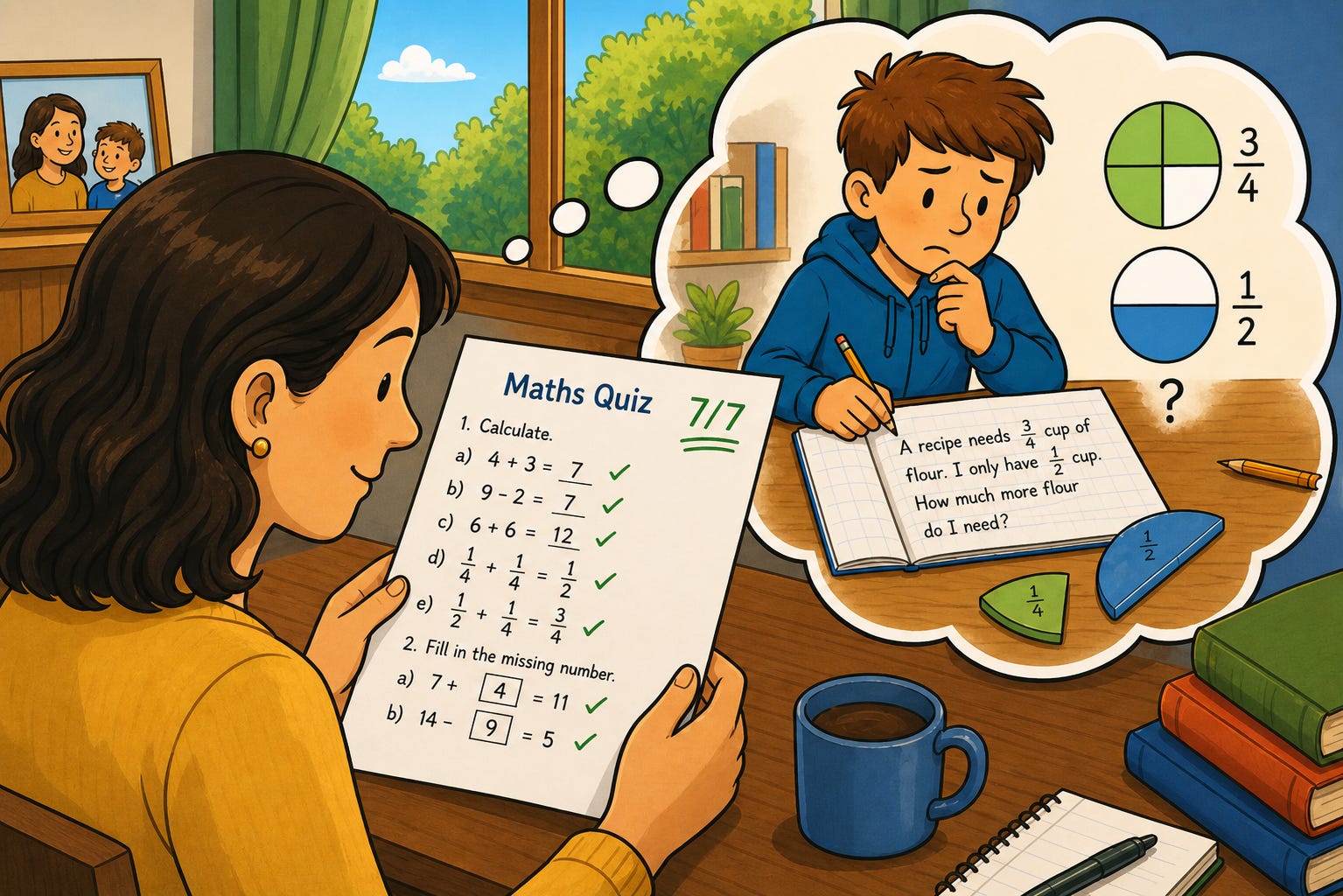
Most parents check in on maths the same way. A glance at the homework, a question after a test, a note in a school report. The answers come back in numbers and ticks, and on the surface, it usually looks fine.
But if you have ever felt unsure whether your child is actually moving forward, you are not imagining it. Maths progress is one of the hardest things for parents to see, because the most useful signs rarely show up where we are looking.
“They did well on the quiz, but I’m not sure they really got it.”
That uncertainty often says something important.
Activity is easy to measure. Learning isn’t
Maths is built to be measurable. There are right answers, wrong answers, and a running tally. What your child has done is easy to see, but what they have understood is much harder to know.
A child can complete a worksheet, score reasonably well, and still be relying on memory, pattern-spotting, or quiet guesswork to get through. The work looks done, however, the understanding underneath it can be much thinner than it appears.
This is especially true in maths because each topic tends to lean on the ones before it. A child might appear to move past fractions, only to find percentages harder later. They might cope with basic multiplication, but struggle when the same thinking appears inside algebra. Small gaps do not always announce themselves straight away. They often wait until the next layer of learning is placed on top.
This is the gap most parents sense but cannot quite name. The work is getting done, but progress is not always being made.
Mastery is what makes progress last
Marks are useful, but they measure a single moment. They tell you how a child performed on a particular task on a particular day. But it does not tell you whether the concept will hold up next term, or whether your child can apply it when the question is worded differently.
Real progress in maths looks more like this. A child who once needed help with a concept can now work through it on their own. A topic that caused frustration last month is approached with less hesitation. A question phrased in a new way still makes sense, because the underlying idea has stuck.
Performance is what happens in the moment. Understanding is what remains when the format changes, the numbers are different, or the topic comes back weeks later.
That is mastery. And mastery is what gives the next topic somewhere solid to land. Without it, children may keep moving through the work, but they are not always moving forward.
Confidence is part of progress too
Confidence does not always show up on a page either, but it is one of the most reliable signals that real progress is happening.
It shows up in small, easy-to-miss ways. A child who used to avoid maths homework starts it without being asked. A question they might have avoided last month gets a genuine attempt. They are willing to be wrong, try again, and explain their thinking out loud.
These shifts often appear before grades catch up. They are quieter than test scores, but they are usually a more honest indicator of how a child is travelling.
Progress should feel clearer
In maths, real progress is not just higher marks or more completed work. It is a deeper understanding. Stronger foundations. Growing confidence. The ability to use what has been learned again, in a new situation, without needing to start over.
Most parents are not asking for more numbers. They are asking for clearer signals. The kind that shows whether the learning is sticking, where it is wobbling, and how their child is feeling about it along the way.
That kind of visibility has been hard to come by but it does not need to stay that way.