
Why school reports don’t tell the full story of your child’s learning
You read the report. You still have questions. You're not alone.

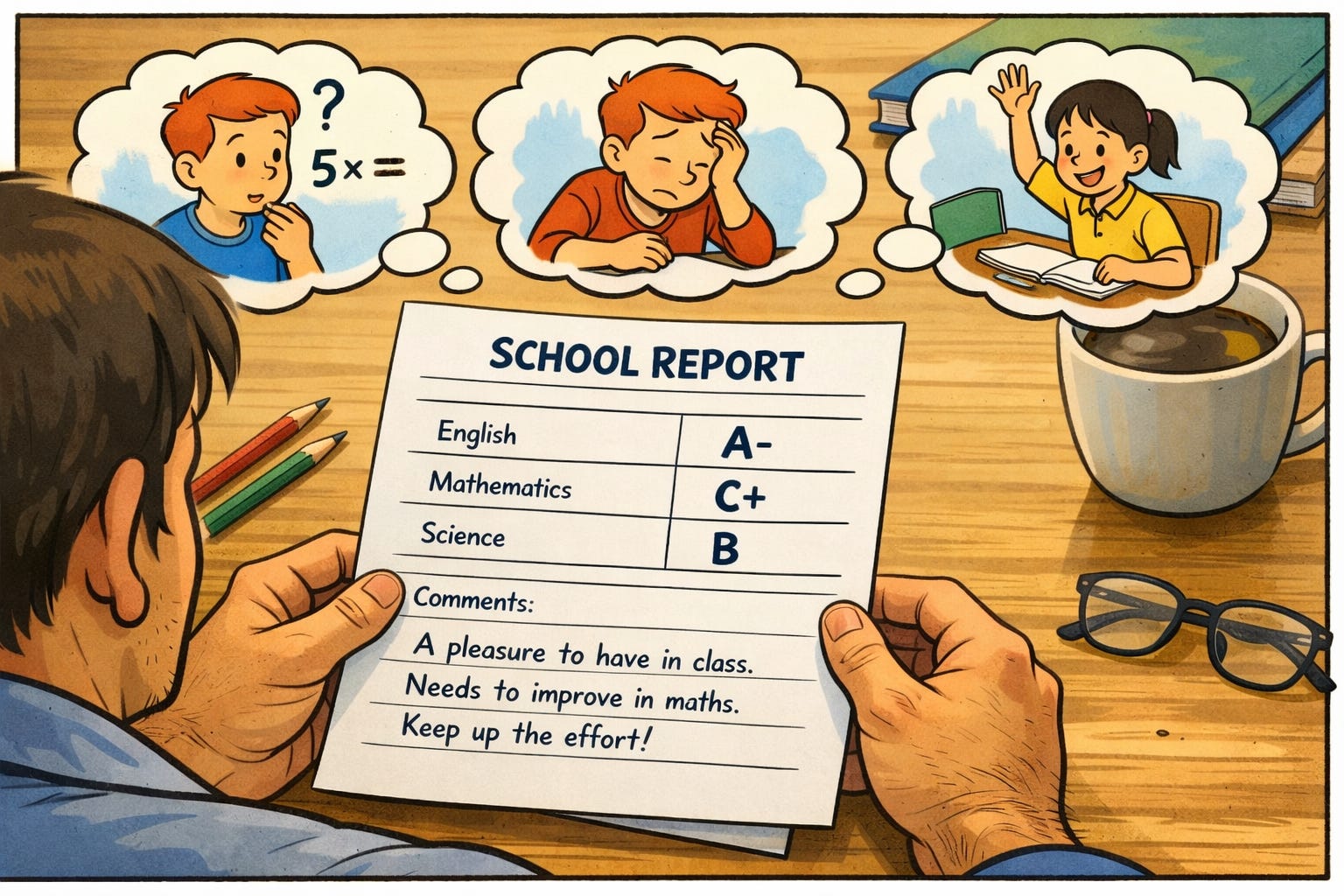
There’s a particular feeling that comes with opening a school report. You scan the grades, read the teacher’s comments, and for a moment it all seems clear enough. Your child is doing well in English. Maths needs some work. They’re a pleasure to have in class.
And then you put it down and realise you still don’t really know how they’re going.
Not in the way that helps you understand whether they’re struggling quietly, whether something isn’t clicking, or whether the confidence they show at home is real.
The grades may be fine. But the question sitting in the back of your mind remains unanswered. “How is my child really going?”
Why school reports feel incomplete
It’s not that school reports are wrong. It’s that they feel incomplete.
They were never designed to give parents the kind of visibility they are often looking for. Reports are periodic by nature. They arrive once or twice a year, based on a snapshot in time. A lot can happen in the months between them, and much of that never shows up clearly in a grade.
They are also written at a high level. A teacher managing a full class cannot always capture the detail of how each child approaches a problem, what they do when they get stuck, or whether they ask for help or quietly avoid it. What parents receive is a summary. And that is not about blaming teachers. It’s a reasonable summary. But it is still just that: a summary.
Think about a child who struggles with fractions for three weeks in Term 3, works around it, and gets an end of year school report with a C+ and a comment that says ‘making steady progress.’ Nothing is technically wrong. But something is missing.
Grades measure outcomes, not the full process behind them. They can tell you what your child got right or wrong, but not always whether they understood the work deeply, relied on guesswork, or whether they are building real confidence along the way.
When “fine” isn’t the whole picture
A child can look completely fine on paper while quietly finding things harder than they seem.
Learning gaps often build slowly, as a child moves through new concepts without fully mastering the ones that came before.
By the time the struggle becomes visible in a school report, or in a moment of real frustration, it has often been there for a while.
Parents can usually sense this before they can explain it. There’s a vague unease that sits alongside a perfectly acceptable report card. A feeling that you’d like to know more, but you’re not sure what questions to ask or where to look.
This is not a failure of parenting. It is a failure of visibility.
What parents actually want to know
Most parents are not asking for more data. They are asking for clearer signals.
They want to know whether their child is understanding the material, not just completing it. They want to know when something is not clicking before it becomes a bigger problem. And they want to understand not just what grade their child received, but how they are learning and how they are feeling along the way.
Most of all, parents want this in a form that feels useful, not overwhelming. They do not want to become subject matter experts or decode the curriculum on their own. They simply want to feel informed enough to support their child with confidence.
School reports still matter. They always will. But they were never designed to tell the whole story, and for most families, the feeling that something is missing is completely valid. The good news is that this is starting to change.